

Read the book “Virtuosity: risk and Excess in Poetic Form” by the Irish poet-critic Ailbhe Darcy this morning. It makes some really great, provocative points, challenging traditional notions of both “mastery” and experimentalism.
I’ve frequently objected to the rhetoric of mastery in the arts - mostly because it tends to function conservatively. In translation it tends to induce anxieties - “Do I know this language well enought? Have I mastered this language?” - that keep people from actually translating or publishing their translations. It also always struck me as false: Can you really master a foreign langauge? Can you master a poem? Is that the best way of engaging with art?
But it of course pervades just poetry discussions in general. But in poetry it tends to be conservative because it invokes notions of taste. To have mastery over the art means to be tasteful, having learnt good taste. So that - like the translators - people get nervous about having written bad poems. Again: is fulfilling rules of decorum the best most exciting way of writing - or reading! - poetry? I don’t think so.
This is where we get to Darcy’s book. This rhetoric of mastery tends to portray people who don’t follow the decorum rules - ie tasteless writers and artists - as somehow unskilled, lacking in abilities, when it mostly strikes me that the people who are tasteless tend to be the ones who have too much skill. Think El Greco, think Ghostface Killah.
Well in her book Darcy sets up as an alternative to this kind of conservative/trad mastery - “virtuosity.” This is the kind of mastery that leads to excess. For example, she describes how Paganini would “enthrall” his audience by playing too many notes, in acts of “virtuoso sublime”: “we can think of virtuosity as a mode that does not merely fulfils artistic laws but over-fulfils them, performing them so thoroughly they begin to implode.”
In the chapter “Language Deluge: Joyelle McSweeney’s Toxicon and Arachne,” Darcy uses this model of excessive virtuosity to analyze Joyelle’s work, importantly drawing out the political consequences of this stance, and how Joyelle’s stance is fundamentally different from so much experimental poetry.
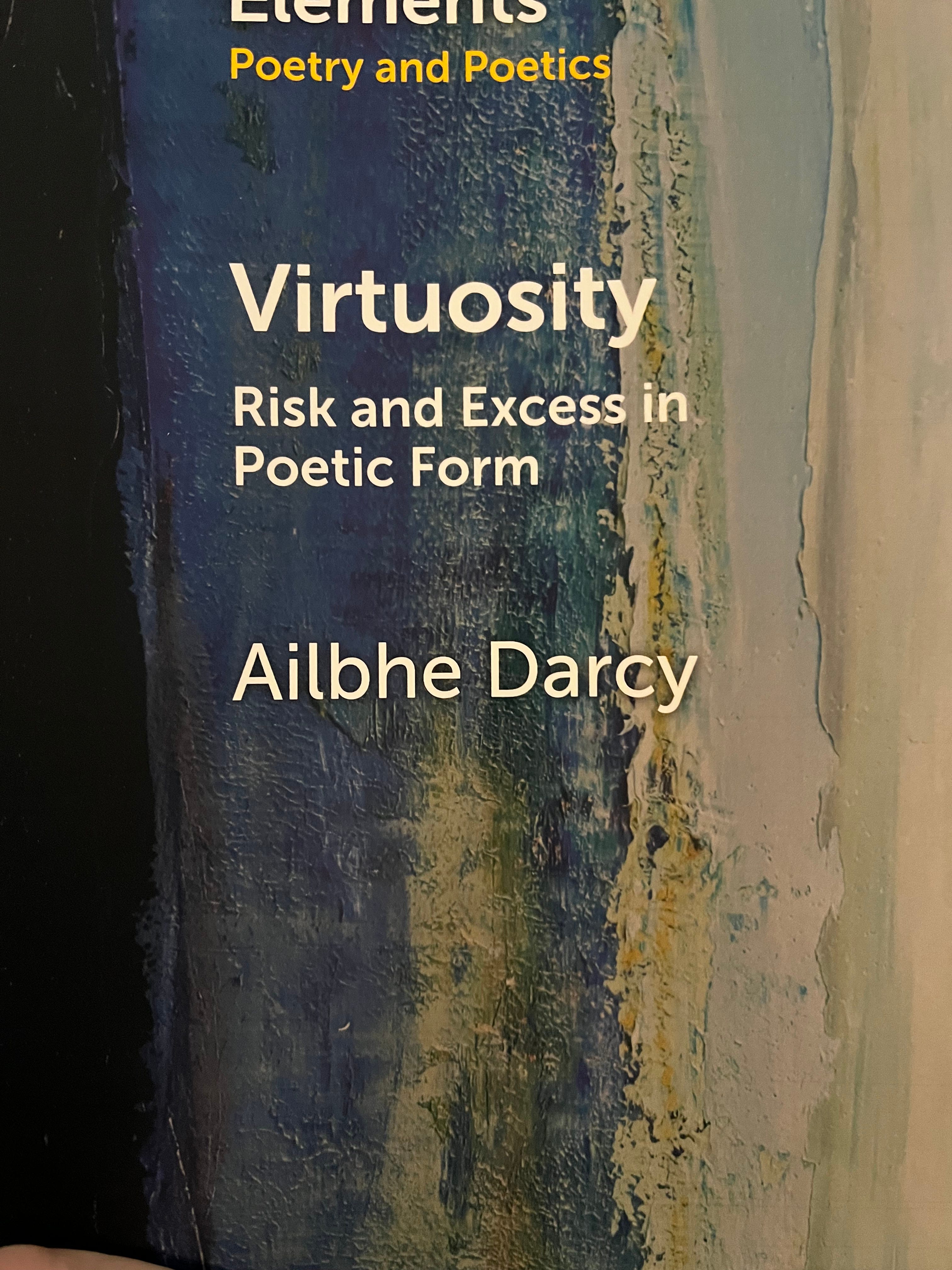
This paragraph is such a good description of Joyelle’s work:
“McSweeney’s insistence on speed and swerve challenges any sense of the lyric as the crystallization of a moment, contemplative and out of time. Her poems drag multiple registers into the same temporal zone: myth, history, pop culture, liturgy, compressing references as they go. A single utterance carries multiple overlapping temporalities, past and future compressed into a single moment. In other words, the poems don’t only move forward at speed, they also fold up historical time. This compressed temporality is something akin to the sense of temporal acceleration felt under late capitalism, in which sensory and cognitive overload become habitual.”
Darcy draws a contrast between the way Joyelle’s “virtuosity” sets up the writer-reader relationship with the way US experimentalists like Juliana Spahr has set up a collaborative/democratic relationship, where the reader is a “co-creator”":
Spahr’s is an understanding of avant-garde poetry thgat many other poets, critics and readers share, and one that remains valuable. Her vision of reading as a collective, emancipatory act continues to shape how we think about the politics of form. Yet McSweeney’s work tests teh limits of this democratic ideal. Her poetry doesn’t invite equal engagement; it assails the reader with a field of affective intensity. My suggestion is that the notion of the equal, co-creative reader so common in accounts of experimental and avant-garde poetry may not account for the affective domination - the virtuosity - that certain poems stage. In such poems, the reader is not co-creator so much as co-witness, drawn into a catastrophic intimacy with the poem’s grief and rage… Where Spahr’s reader co-creates, McSweeney’s undergoes.
I really love the way Darcy opens up this traditional model of avant-garde writing - a model that I never liked. Although she doesn’t mention it, Darcy’s book for me invokes Leo Bersani’s The Culture of Redemption, in which Bersani criticizes the idea that art should heal history. It can’t - and in the process this model loses the art-ness of art. Darcy’s chapter on Joyelle very much comes out against “redemption”: ““hers is a radical revision of the virtuoso figure: no longer a sovereign artist imposing mastery on material, but a figure caught in a bind: “mastery and submission” locked together in the “ampersand” of the anthropocene.”
Here’s the web page on the Cambridge UP website. This is a very good read, two thumbs up, get reading.
Thank you for sharing this!